The Better (Best) Way to Mix Metal Powders:
ResonantAcoustic® Mixing (RAM)
Metal powder mixing is a critical step in powder metallurgy, additive manufacturing, metal injection molding, thermal spray coatings, and advanced alloy development. The quality of the final product often depends on how uniformly powders, additives, binders, lubricants, or reinforcement materials are distributed throughout the blend.
Traditional mixing technologies such as V-blenders, tumble mixers, ribbon blenders, and ball mills have been widely used for decades. However, these systems can present challenges including segregation, long processing times, particle damage, contamination, and scale-up difficulties.
Resonant Acoustic Mixing (RAM®) technology from Resodyn offers a fundamentally different approach. By using low-frequency acoustic energy to fluidize and mix powders without blades, impellers, or direct contact mechanisms, RAM enables rapid, uniform mixing while preserving particle integrity.
What is Resonant Acoustic Mixing?
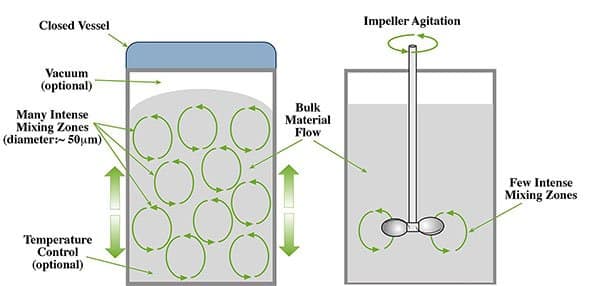
Resonant Acoustic Mixing uses controlled acoustic energy to create a uniform mixing environment throughout the entire powder bed.
Unlike conventional mixers that rely on rotating vessels, agitators, or impellers, RAM transfers energy through resonant acoustic vibrations. This energy fluidizes powders and promotes particle movement in all directions, resulting in efficient mixing throughout the vessel.
The process is:
- Bladeless
- Non-contact
- Scalable
- Suitable for dry or wet processing
- Effective across a wide range of particle sizes and densities
Because there are no internal mixing tools, materials can often be processed directly within their production container, reducing handling steps and contamination risks.
Challenges of Traditional Metal Powder Mixing
Metal powders present unique mixing challenges due to variations in:
- Particle size
- Particle shape
- Density
- Surface chemistry
- Flowability
Conventional mixing methods can encounter several problems:
Segregation
When powders differ in density or particle size, heavier or larger particles may separate during blending and handling.
Particle Damage
High-energy ball milling can fracture particles, alter morphology, and reduce flowability.
Contamination
Impellers, blades, and milling media may introduce contamination from wear surfaces.
Long Processing Times
Many powder blends require mixing times ranging from 30 minutes to several hours.
Scale-Up Difficulties
Mixing performance achieved in a laboratory blender may not translate directly to production-scale equipment.
Advantages of RAM for Metal Powder Mixing
Rapid Blend Homogeneity
RAM can achieve highly uniform metal powder mixing blends in minutes rather than hours.
The acoustic energy creates three-dimensional particle motion throughout the entire material volume, reducing dead zones commonly found in conventional mixers.
Benefits include:
- Faster blend development
- Reduced manufacturing cycle times
- Improved production throughput
Preservation of Particle Morphology
One of the most significant advantages of RAM is its ability to maintain particle integrity.
Unlike ball milling, RAM does not rely on grinding media or high-impact collisions.
This helps preserve:
- Particle size distribution
- Powder sphericity
- Flowability
- Packing characteristics
These properties are particularly important in additive manufacturing and metal injection molding applications.
Superior Distribution of Fine Additives
Many metal powder formulations require the addition of:
- Nanoparticles
- Alloying agents
- Lubricants
- Binders
- Flow aids
- Reinforcement materials
RAM excels at distributing low-concentration additives uniformly throughout bulk powder blends.
Applications include:
- Oxide dispersion strengthened alloys
- Metal matrix composites
- Additive manufacturing feedstocks
- Thermal spray powders
Reduced Risk of Contamination
Because RAM contains no internal blades, paddles, or milling media, there are fewer wear surfaces that can contaminate sensitive materials.
This benefit is especially important when processing:
- Aerospace alloys
- Reactive metals
- High-purity powders
- Specialty alloys
Dry Mixing Performance Comparable to Wet Processing
Historically, wet slurry mixing has been used to achieve high levels of powder homogeneity.
However, wet processing introduces:
- Solvents
- Drying requirements
- Additional equipment
- Increased production costs
RAM often achieves comparable blend uniformity while maintaining a dry process, eliminating the need for solvent handling and drying operations.
Applications in Additive Manufacturing
Additive manufacturing demands extremely consistent powder feedstocks.
Poor powder homogeneity can lead to:
- Part defects
- Inconsistent chemistry
- Reduced mechanical properties
- Process instability
RAM is used for:
Alloy Development
Rapid blending of experimental compositions.
Nanoparticle Coating
Uniform distribution of nanoparticles onto larger metal powder surfaces.
Feedstock Preparation
Preparation of highly homogeneous powders for:
- Laser Powder Bed Fusion (LPBF)
- Directed Energy Deposition (DED)
- Binder Jetting
Powder Recycling
Reconditioning and homogenization of recycled powder streams.
Powder Metallurgy Applications
In powder metallurgy, RAM can be used for:
- Lubricant incorporation
- Alloy blending
- Reinforcement distribution
- Binder addition
- Composite powder preparation
The ability to maintain particle morphology while achieving excellent homogeneity can improve:
- Green density
- Sintered density
- Mechanical performance
- Product consistency
Metal Matrix Composite Production
Producing metal matrix composites often requires uniform dispersion of small amounts of reinforcement materials such as:
- Silicon carbide
- Alumina
- Carbon nanotubes
- Graphene
- Ceramic nanoparticles
Traditional mixing approaches may leave agglomerates or create uneven distributions.
RAM enables efficient deagglomeration and dispersion while minimizing particle damage.
Scale-Up Without Process Redesign
One challenge in powder processing is transferring laboratory results to production.
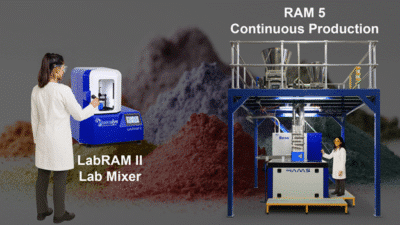
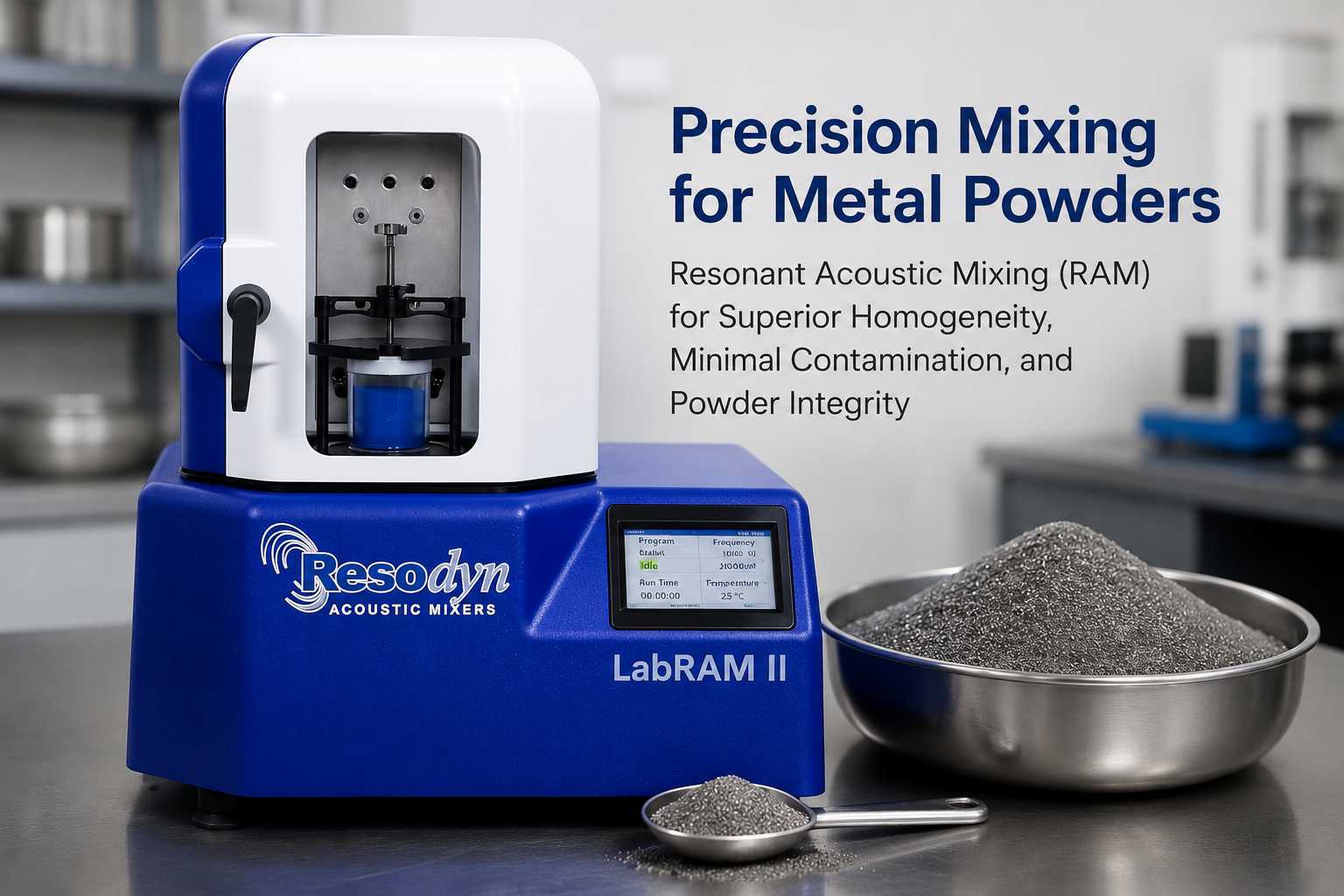
Resodyn's RAM technology is available across a range of scales, from laboratory systems such as the LabRAM II to large-scale production systems.
This enables manufacturers to:
- Develop formulations at small scale
- Maintain process consistency during scale-up
- Reduce development time
- Accelerate commercialization
Research and Industry Adoption
RAM technology has been adopted across industries including:
- Aerospace
- Defense
- Battery manufacturing
- Pharmaceuticals
- Additive manufacturing
- Advanced materials research
Published studies have demonstrated the ability of acoustic mixing to achieve:
- Excellent blend uniformity
- Uniform nanoparticle distribution
- Reduced segregation
- Faster processing compared to conventional blending methods
Researchers have also shown that RAM can achieve homogeneity comparable to wet processing while preserving powder morphology.
The Ultimate Metal Powder Mixer
As metal powder mixing applications become increasingly sophisticated, manufacturers require mixing technologies that deliver both exceptional homogeneity and preservation of powder characteristics.
Resonant Acoustic Mixing offers a unique solution by combining:
- Bladeless operation
- Rapid mixing
- Excellent powder uniformity
- Minimal particle damage
- Reduced contamination risk
- Scalable processing
For additive manufacturing, powder metallurgy, and advanced alloy development, RAM provides an efficient alternative to conventional blending and milling technologies, helping manufacturers improve product quality while reducing processing time and operational complexity.
Whether preparing additive manufacturing feedstocks, metal matrix composites, or advanced alloy powders, Resonant Acoustic Mixing represents a modern approach to achieving consistent, high-performance powder blends.