
Home » Applications »
the high viscosity mixer that easily processes viscous pastes Other Mixers Can't
What is Viscosity?
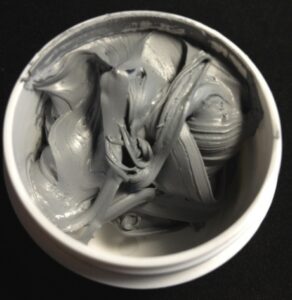
Viscosity is a measure of how resistant a fluid is to flow and is measured in centipoise (cP) and is one of the properties that influences how easily a mixture can achieve homogeneity.
Low viscosity materials - such as water and other liquids, have a lower resistance and flow more rapidly. Water has a viscosity of 1 cP.
High viscosity materials - such as honey or tar resist deformation and flow more slowly. Honey has a viscosity ranging from 2,000 to 10,000 cP. Some highly viscous materials have a viscosity of hundreds of millions centipoise.
Pastes, slurries and highly viscous mixes are made up of solids in a liquid matrix. Less liquid in the matrix produces higher viscosity – approaching what appears to be and behaves much like a solid.
High-viscosity mixing doesn’t have to be slow or inconsistent. Resodyn’s LabRAM delivers fast, thorough mixing—even for the toughest materials.
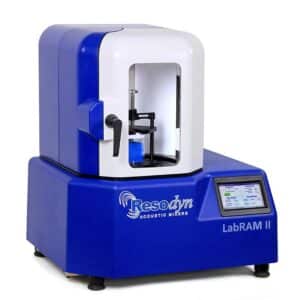 Resonant Acoustic Mixing (RAM) easily mixes highly viscous materials at speeds and uniformity that no conventional bladed mixer compares to. Using sound energy, RAM's bladeless high viscosity mixers deliver wetting, incorporation, and widespread mixing rapidly and uniformly throughout the material matrix.
RAM mixers accelerate these processes by inducing Faraday Instabilities, or invasive “fingers” coupled with enveloping “cavities” at the boundary between materials of different densities. RAM delivers highly homogeneous, higher viscosity results significantly faster than traditional technologies.
Overcome Mechanical Restrictions
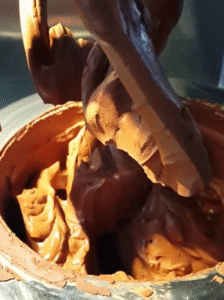 Traditional, blade and axis technologies can work through early stages of wetting and possibly incorporation, but often overheat or grind to a halt when mixing starts and the viscosity increases.
Every highly viscous mixing process requires wetting, incorporation, and mixing phases. Without the mechanical limitations of axis/blade methods that require all materials to pass through a limited mixing zone, RAM technology performs all three steps simultaneously and consistently throughout the mixing vessel, reducing processing time by orders of magnitude.
Low Shear Mixing Regardless of Viscosity
RAM technology is a “non-contact” mixing method requiring no blades, propellers, or other engineered devices to cause mixing. This also means that the high shear traditionally associated with viscous materials is eliminated, allowing delicate or hazardous materials to be processed rapidly without excessive heat build-up or physical shear stress.
RAM is low shear mixing that protects your sensitive and expensive materials from damage.
Rapidly Achieve Uniformity in High Viscosity Materials
The more viscous a material, the more difficult it is to mix traditionally. This means that consistent dispersion and distribution suffer at higher centipoise. These restrictive phenomena are completely avoided using RAM mixers at any scale.
Sound energy wets, incorporates, and mixes materials rapidly, thoroughly and at levels of quality not previously possible. Over years of test data across numerous industrial installations, RAM devices have delivered exceptional results, well into the tens of millions of centipoise.
RAM Processing Accessories
Every RAM device’s mixing parameter variables can be enhanced by combinations of vacuum, mixing payload temperature control, and other accessories. Viscous materials often mix more effectively at higher temperatures and under vacuum. RAM systems provide these functions before, during, and after actual mixing operations. This means that idle, degassing time, and failed batches due to the wrong temperature are eliminated.
HOW RAM HIGH VISCOSITY MIXERS DELIVER RESULTS 10x - 100x FASTER
The Mechanics of RAM Mixing
RAM’s high-viscosity mixing technology uses sound energy and Faraday Instabilities to drive intense liquid-to-particle interaction during the wetting stage, rapidly distributing liquid throughout the material for efficient, uniform mixing.
As viscosity increases, RAM continues to deliver powerful mixing without the limitations of traditional bladed systems. With no impellers or blades—and without the heat and shear associated with mechanical mixing—RAM can efficiently process highly viscous materials at high solids concentrations and dense viscosities.
- Vertical vessel movement of 60 x/second and 0.55” / 14 mm displacement, at up to 100 g of acceleration generates intense particle motion.
- RAM’s primary viscous mixing mechanism is intense liquid and solids material boundary interaction, and highly effective sound energy facilitating and accelerating mixing.
- The addition of processing vacuum or temperature improves many viscous ingredient mixes and aids in degassing.
How RAM Mixers Compare to
Traditional High Viscosity Mixers
Stop Excessive Heat and Shear
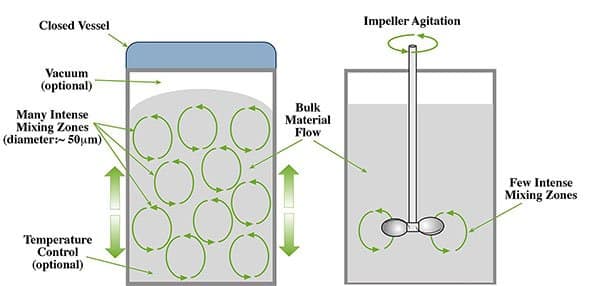
- Traditional high viscosity mixers require all ingredients to traverse the entire vessel to repeatedly enter and exit a small, mechanically driven mixing area to achieve proper mixedness.
- Viscous materials experience high temperature generation and physical shear, damaging many ingredients. RAM technology activates all ingredients throughout the vessel immediately, eliminating material motion without mixing. RAM mixes everywhere in the vessel without mechanical devices or accessories, reducing temperature generation and eliminating physical shear.
Bringing Quality to High cP Processing
- High quality viscous performance requires thorough distribution of solids in the liquid matrix, for consistent processing characteristics at any place in the final product.
- RAM’s intense and pervasive processing facilitates solid particle separation and dispersion, improving dispersion, consistency, and performance.
Real World High Viscosity Mixer Applications
Battery electrode slurries. Cathode and anode slurries for lithium-ion and solid-state batteries are among the most challenging high viscosity mixing applications in industry. Achieving uniform distribution of active materials, conductive additives, and binders — without damaging fragile particle structures — is critical to cell performance. RAM routinely reduces electrode slurry processing time from 45–90 minutes to 2–5 minutes, while delivering superior homogeneity that directly translates to better, more consistent cell performance.
Pharmaceutical semi-solids. Topical creams, ointments, and pastes present a classic high viscosity challenge: API must be uniformly dispersed through a viscous, often multi-phase base without shear-induced degradation. RAM achieves this in minutes rather than hours, with API uniformity that meets FDA content uniformity requirements on the first blend.
Ceramic pastes and slurries. Advanced ceramics processing often involves highly filled, high viscosity slurries that are difficult to homogenize and prone to settling or agglomeration. RAM delivers thorough dispersion of ceramic particles without the extended ball milling times that conventional processing requires.
Adhesives and sealants. High viscosity adhesive formulations — filled epoxies, polyurethane sealants, silicone compounds — benefit enormously from RAM's ability to uniformly disperse fillers, pigments, and reactive components throughout a viscous matrix without introducing air or causing pre-cure degradation.
Energetic materials. The defense and aerospace industries have adopted RAM for processing energetic material pastes and compositions where both the viscosity challenge and the sensitivity of the materials make conventional mixing hazardous and unreliable.
RAM vs. Conventional Mixing
The performance advantage of RAM for high viscosity mixing can be summarized simply:
- Processing time: 1–5 minutes vs. 30–180 minutes with conventional mixing
- Blend uniformity: RSD <1% routinely achieved
- Scale-up: Direct from lab to production, zero reformulation
- Equipment: One unit replaces three (mixer, mill, sieve)
- Material integrity: No shear damage, no heat generation, no contamination
High viscosity mixing has always been a compromise — between processing time and uniformity, between mixing efficiency and material integrity, between lab-scale results and production-scale reality. Those compromises exist because conventional mixing technology is fundamentally limited in what it can achieve with resistant materials.
ResonantAcoustic® Mixing eliminates those compromises. By replacing mechanical agitation with acoustic energy, RAM achieves what no blade or paddle can: simultaneous whole-batch mixing that is fast, uniform, gentle, and directly scalable — regardless of viscosity.
For any operation where high viscosity processing is a bottleneck, a quality problem, or a development constraint, RAM is not an incremental improvement. It is a replacement for the entire conventional approach.
Get a FREE ResonantAcoustic® Mixing Demonstration for Your High Viscosity Materials
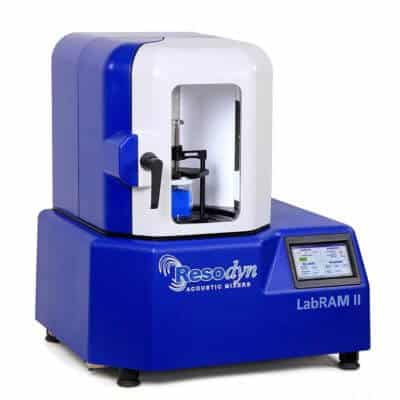
We can schedule an on-site or online video demonstration with a LabRAM I or II (bench scale) mixer to show you the incredible versatility of RAM high viscosity mixing technology. We can mix any materials you wish to test, and we love challenging mixes!
- Mix 10x to 100x faster
- Eliminate cleanup & cross contamination
- Exceptionally thorough and consistent mixing
- Only available through Resodyn
HIGH VISCOSITY MIXING VIDEOS WITH RAM
Highly Viscous, Loaded Polymer Blending in Less than 3 Minutes!
To illustrate a heavily loaded polymer blend, two materials of very different particle sizes are blended with a polymer surrogate. This footage documents the nature of the material blending and integration into a heavily loaded (~85%) polymer based paste in just over 2 minutes. The use of RAM™ technology is ideally suited for loading of solids into polymers and mixing to a high rate of dispersion and consistent viscosity throughout the blend.
