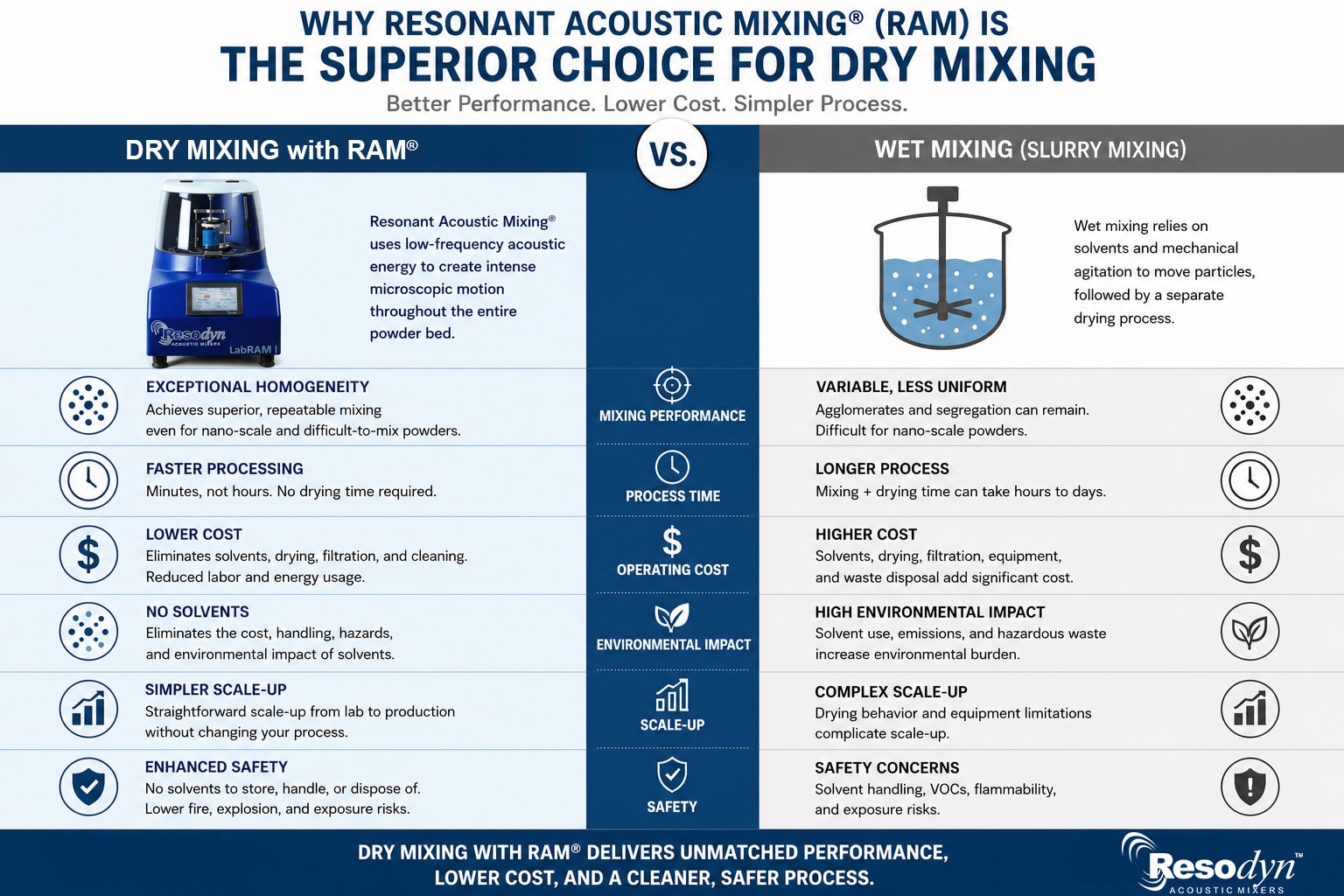
When it comes to powder mixing, wet mixing generally produces higher homogeneity than dry mixing, particularly when blending powders that differ in particle size, density, shape, or composition. However, the best choice depends on the material system and manufacturing process. And with acoustic mixing you can usually have the best of both worlds.
Dry Mixing
How it works:
Powders are blended without a liquid carrier using tumblers, V-blenders, ribbon mixers, or acoustic mixers.
Advantages
- No drying step required
- Lower processing cost
- No solvent handling or environmental concerns
- Suitable for free-flowing powders with similar particle characteristics
Challenges
- Segregation can occur after mixing due to differences in:
- Particle size
- Density
- Shape
- Difficult to uniformly distribute very small amounts of additives
- Agglomerates may remain intact
- Fine powders can generate dust and static charge
Typical Homogeneity
- Coefficient of Variation (CV) often ranges from 2–10%, depending on the powder system and mixer.
- Well-designed dry blending processes can achieve <2% CV in some applications.
Wet Mixing
How it works:
Powders are dispersed in a liquid (water or solvent), mixed into a slurry, and then dried.
Advantages
- Liquid acts as a transport medium, reducing segregation
- Better distribution of fine additives and binders
- Breaks apart agglomerates more effectively
- Produces more uniform particle-to-particle contact
- Often preferred for alloy precursor preparation and ceramic processing
Challenges
- Requires drying and solvent removal
- Potential contamination from solvent
- Possible oxidation of reactive metal powders
- Additional processing time and cost
Typical Homogeneity
- CV values can often be reduced to <1–2%
- Frequently achieves superior elemental distribution compared to dry blending
Research Findings
Studies in powder metallurgy and battery materials consistently show:
| Factor | Dry Mixing | Wet Mixing |
| Blend Uniformity | Good | Excellent |
| Segregation Risk | Moderate to High | Low |
| Fine Additive Distribution | Fair | Excellent |
| Processing Cost | Lower | Higher |
| Oxidation Risk | Low | Potentially Higher |
| Drying Required | No | Yes |
For example:
- Metal matrix composites often achieve significantly better reinforcement dispersion using wet mixing.
- Ceramic and alloy powder systems frequently use wet mixing to achieve near-perfect distribution before spray drying or granulation.
- In battery cathode precursor production, wet processing is commonly used specifically to maximize compositional uniformity.
Where Resonant Acoustic Mixing (RAM) Fits
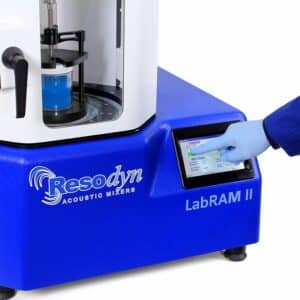
One of the advantages of Resodyn's ResonantAcoustic® Mixing technology is that it can achieve dry powder homogeneity levels approaching those traditionally associated with wet processing, while avoiding:
- Solvent use
- Drying steps
- Segregation from impellers or blades
Several published studies in powder metallurgy and battery materials have reported highly uniform dry blends using RAM, particularly for:
- Metal powders
- Additive manufacturing feedstocks
- Battery electrode materials
- Energetic formulations
For additive manufacturing metal powders, many users pursue RAM specifically to obtain wet-mixing-level uniformity without the cost and complexity of wet processing and drying.
Here's published data comparing RAM dry mixing homogeneity versus ball milling, V-blending, and wet slurry mixing.
Head to Head Comparison RAM Dry Mixing Homogeneity Vs. Ball Milling, V-Blending and Wet Slurry Mixing
Published head-to-head comparisons between Resonant Acoustic Mixing (RAM), V-blending, ball milling, and wet slurry mixing are relatively limited because most studies compare RAM to the incumbent process used in a specific industry. However, several peer-reviewed papers and case studies provide useful quantitative data on homogeneity and dispersion quality.
-
Low-Dose Pharmaceutical Powder Blends
Osorio & Muzzio et al. (RSC Advances, 2016)
"Evaluation of Resonant Acoustic Mixing Performance"
Researchers compared RAM to conventional powder blending approaches for low-dose formulations.
Results
| Metric | Traditional Blending | RAM |
| Blend uniformity CV | Typically 3–8% | <1–2% |
| Blend time | 20–60 min | 2–10 min |
| Segregation resistance | Moderate | High |
Key finding: RAM produced highly uniform blends with less segregation and significantly shorter processing times.
Reference:
- Osorio JG et al., RSC Advances, 2016, 6, 56910–56919.
-
Battery Cathode Materials
Titirici Group (Imperial College London)
Several studies evaluating dry electrode manufacturing and mechanochemical processing reported that RAM achieved homogeneous conductive additive distribution without solvents.
Results
| Process | Carbon Distribution | Mixing Time |
| V-Blender | Poor to moderate | 30–120 min |
| Ball Mill | Excellent dispersion but particle damage possible | 1–12 hr |
| RAM | Excellent dispersion | 5–20 min |
Researchers noted:
- RAM produced conductive carbon networks comparable to wet processing.
- Less particle fracture than high-energy ball milling.
- Better preservation of active material morphology.
-
Additive Manufacturing Metal Powders
NASA / GRX-810 Development
NASA and collaborators used acoustic mixing during development of oxide-dispersion-strengthened alloys.
Findings
Uniform coating and distribution of nanoscale oxides was achieved without high-energy milling.
Compared with traditional ball milling:
| Metric | Ball Milling | RAM |
| Particle morphology damage | High | Minimal |
| Contamination risk | Moderate | Low |
| Blend uniformity | Excellent | Excellent |
| Processing time | Hours | Minutes |
Researchers reported RAM maintained powder sphericity while achieving highly uniform additive distribution.
Reference:
- Smith et al., NASA Glenn Research Center publications on GRX-810 processing.
-
Energetic Materials
BAE Systems / Defense Studies
Published work comparing acoustic mixing with conventional impeller and tumble blending showed:
| Metric | Tumble Blender | RAM |
| Mix time | 30–120 min | 5–15 min |
| Uniformity CV | 2–5% | <1–2% |
| Segregation after handling | Moderate | Lower |
RAM provided more homogeneous binder and additive distribution while reducing processing steps.
-
Dry Powder Coating Studies
Mechanochemistry and Powder Coating Research
Several groups (including Friščić, Michalchuk, and collaborators) have shown RAM can achieve:
- Uniform nanoparticle coating on larger particles.
- Comparable coating quality to wet slurry methods.
- Elimination of drying steps.
Typical results:
| Method | Coating Uniformity |
| V-Blending | Poor |
| Wet Slurry | Excellent |
| RAM | Excellent |
| Ball Milling | Excellent but can deform particles |
Summary of Published Trends
| Metric | V-Blending | Ball Milling | Wet Slurry Mixing | RAM |
| Blend Homogeneity | Moderate | Moderate | Moderate | Excellent |
| Typical CV | 2–10% | <1–2% | <1–2% | <1–2% |
| Processing Time | 30–120 min | 1–12 hr | Hours + drying | 2–20 min |
| Particle Damage | None | High | None | Very Low |
| Solvent Required | No | No | Yes | No |
| Drying Required | No | No | Yes | No |
| Segregation Resistance | Moderate | High | High | High |
| Scale-Up Complexity | Moderate | High | High | Low |
Overall conclusion:
Published studies show that RAM achieves homogeneity far better to ball milling and wet slurry mixing, while preserving particle morphology and eliminating solvent and drying requirements.
Compared with V-blending, RAM typically delivers:
- Lower coefficient of variation (CV)
- Faster mixing times
- Better additive dispersion
- Reduced segregation
For metal powders used in additive manufacturing, the most frequently reported advantage is that RAM can achieve ball-mill-level dispersion without destroying powder sphericity, which is critical for powder flowability and part quality.