Resonant Acoustic Mixing vs. Traditional Mixing — A Fundamental Shift in How the World Mixes
How Traditional Mixing Works — and Where It Falls Short
Traditionally, mixing has been accomplished using motor-driven impellers, blades, and other engineered devices that rotate in or otherwise agitate the ingredients. These methods, however, present several challenges including degradation of particles during mixing, non-uniform and inconsistent mix quality, and extended mixing times.
Beyond these core limitations, traditional mixers are also highly application-specific. Most traditional mixers are only effective for specific materials — paddle mixers are more effective for viscous materials, and agitators are best suited for liquids. This means manufacturers often require multiple different pieces of equipment to handle the range of materials and formulations in their production environment — adding capital cost, floor space, operator training burden, and maintenance complexity.
Traditional mixers also present significant contamination and cleaning challenges. Traditional mixer configurations involve mechanically-driven internal parts that are difficult and time-consuming to clean and prone to introducing impurities. To improve cleanliness, some companies use customized mixing fittings and connectors, or swap out spare components during cleaning to reduce production downtime. None of these workarounds eliminate the fundamental problem — they simply manage it.
How Acoustic Mixing Works — A Ground-Up Departure
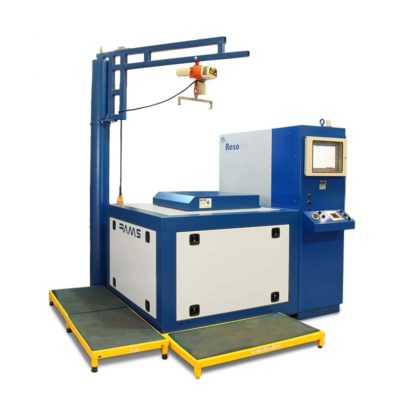
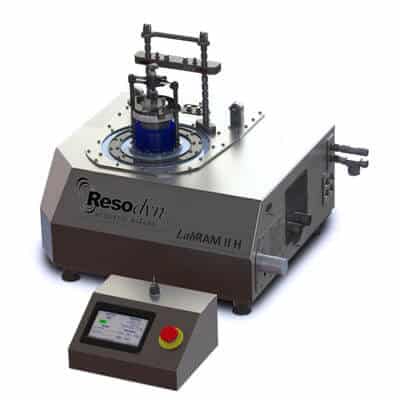
ResonantAcoustic® Mixing (RAM) uses sound energy to generate unique material movement and sound-induced interactions that swiftly result in optimal and uniform mixing. RAM mixers generate and control rapid and relatively large-scale vertical motion to drive movement of the mixer’s resonator plate and thus within the mixing vessel itself. The conditions within the vessel are continuously monitored and adjusted to achieve a “resonant state” — proven to generate the highest rate of energy transfer to optimize mixing of ingredients while consuming the least amount of power, resulting in a very efficient and effective process.
Critically, RAM combines the efficient power generation of resonance and the effects of sound energy to facilitate mixing — without the use of impellers or any other mechanical means within the mixing vessel. There are no blades, no propellers, no baffles, and no internal mechanical devices of any kind making contact with the material. The vessel itself becomes the mixing environment, driven entirely by acoustic energy from outside.
The Key Differences — Side by Side
1. Speed (10x to 100x Faster)
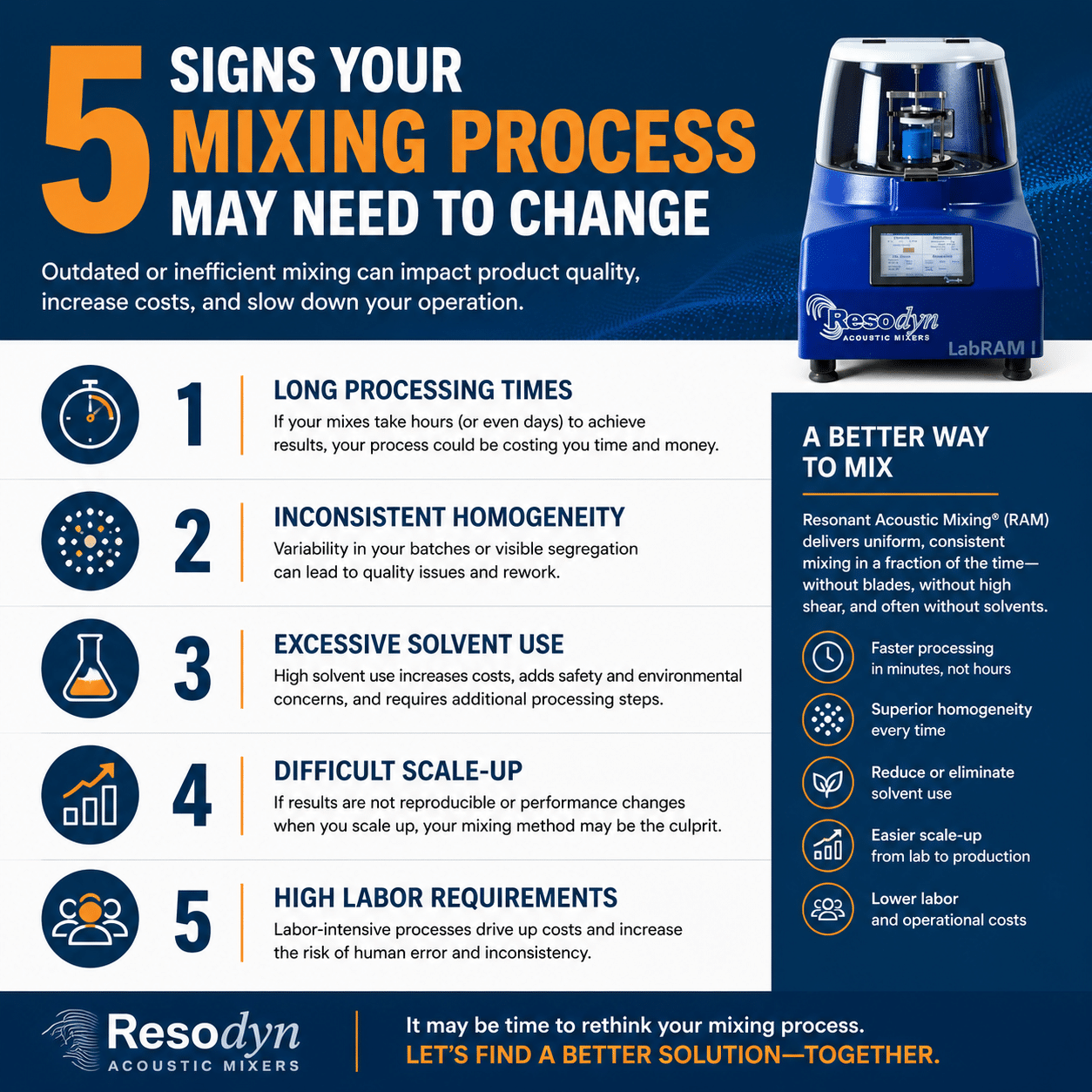
RAM mixers dramatically cut mix times compared to traditional mixers — in many cases from hours to just a few minutes. Mixing times are significantly reduced, often by 10x or more compared to conventional methods. In pharmaceutical applications, customers have reported going from eight hours with an overhead stirrer to just two minutes with a Resodyn RAM system — on the very same formulation.
2. Uniformity & Content Consistency
Where traditional mixers create localized shear zones — areas of intense mixing near blades surrounded by relatively undisturbed material — RAM generates a consistent energy field throughout the entire vessel simultaneously. RAM ensures uniform energy distribution, producing highly reproducible results crucial for R&D and validation studies. This translates directly to better content uniformity, tighter RSD values, and fewer failed batches.
3. Versatility
RAM mixers are extremely versatile and can mix materials conventional mixers can’t. Acoustic mixing effectively blends virtually any combination of powders, liquids, highly viscous or solids-loaded materials. A single RAM system replaces what would otherwise require multiple pieces of specialized traditional equipment — reducing capital expenditure, floor space, and operational complexity in one stroke.
4. Contamination & Cleanliness
Because RAM mixes materials directly inside sealed containers — such as vials, syringes, or jars — there is no cleaning between batches and no risk of cross-contamination, a huge advantage in regulated or high-throughput labs. The RAM method of mixing does not utilize internal engineered components that need cleaning and otherwise complicate sanitation steps, which allows for easier and faster cleanup, changeover, and maintenance.
5. Scalability
One of the most strategically valuable advantages of acoustic mixing is how faithfully formulations scale from bench to production. A given recipe developed at quantities often less than 1,000 grams can be directly scaled to the desired manufacturing volume with no retesting or reformulating necessary. Traditional mixing methods often require extensive reformulation and revalidation at each scale-up step — a costly and time-consuming process that delays commercialization and adds regulatory complexity.
6. Energy Efficiency
ResonantAcoustic® technology harnesses the power of the resonant condition, which has two main effects: the ability to generate high power levels in relatively small packages, and by the nature of resonance, requires very little energy to maintain the resonant state. RAM operations minimize environmental impact with lower overall energy consumption and faster cycle times, even when mixing viscous materials.
7. Safety
For hazardous and energetic materials in particular, the elimination of internal mechanical components is not just a cleanliness advantage — it is a fundamental safety transformation. RAM can reduce the risk of explosion by eliminating the need for mechanical mixers, and can increase the explosive power of munitions by up to 20% while reducing mixing time and waste generated during the mixing process. The sealed, non-contact nature of acoustic mixing means operators are never directly exposed to hazardous materials during the mixing step.
8. Low Shear
High shear mixers are hard on your materials, often rendering them unusable. Since RAM is a bladeless and uses sound energy to mix materials it’s inherently low shear and low heat, which means it does an excellent job preserving your materials.
The Bottom Line
For companies seeking cleaner, faster, and more reliable ways to produce high-quality products, bladeless non-contact mixers like ResonantAcoustic® Mixing represent a game-changing technology. They eliminate common pain points of traditional mixing, reduce costs, and empower innovation in industries that demand precision and performance. Adopting bladeless mixing isn’t just about upgrading equipment — it’s about investing in a smarter, more efficient future for manufacturing.
Resodyn Acoustic Mixers is the only company in the world that offers ResonantAcoustic® Mixing technology — proudly designed, engineered, and manufactured in Butte, Montana.