The Gentle Giant: Low Shear Mixing and Why Resodyn’s Acoustic Mixers Do It Better
What Is Low Shear Mixing — and Why Does It Matter?
In the world of industrial mixing, not all force is friendly. When a rotating blade, paddle, or impeller tears through a batch of material, it creates intense, localized zones of mechanical stress — areas where the fluid is being stretched and torn at a rate far exceeding what many sensitive materials can withstand. This is called shear, and for a surprisingly broad range of applications, too much of it is a serious problem.
Low shear mixing is the discipline of achieving thorough, uniform blending while minimizing those destructive mechanical forces. The goal isn’t to mix gently at the expense of quality — it’s to mix just as thoroughly as any conventional method, while preserving the structural integrity of the material being processed.
The industries that care most about this distinction include pharmaceuticals, biotech, advanced materials, cosmetics, battery manufacturing, and energetics. In each of these fields, the things being mixed are often fragile, expensive, or both. A polymer binder that degrades under high shear. A biological compound whose cellular structure ruptures under blade contact. An active pharmaceutical ingredient that must remain in a precise crystalline form. An emulsion whose droplet size distribution collapses the moment an impeller passes through it. In every one of these cases, the mixing method itself can determine whether the final product is effective — or ruined.
Traditional mixers have always faced a fundamental tradeoff: to mix faster and more completely, you apply more mechanical energy, which means more shear. The result is a constant tension between homogeneity and material integrity. For decades, process engineers have navigated this tradeoff with elaborate workarounds — slower mixing speeds, staged additions, carefully tuned impeller geometries — all trying to get uniform results without destroying what they’re mixing.
Resodyn’s ResonantAcoustic® Mixing technology doesn’t navigate this tradeoff. It sidesteps it entirely. as is the ultimate low shear mixer.
Here’s why RAM is considered the #1 low shear mixer by many of the world’s finest process engineers:
Why RAM Is Exceptional for Low Shear Applications
No Blades, No Shear Zones
The most immediate benefit is structural: because there is nothing physically moving through the material, there are no high-shear zones at all. In a conventional mixer, shear stress peaks near the impeller tip and drops off with distance. RAM eliminates the peak entirely. The energy field is uniform across the vessel, which means the shear experienced by any given particle is consistently low — not low on average with dangerous spikes, but uniformly, predictably low throughout.
This matters enormously for fragile materials. Biological compounds, polymer matrices, encapsulated actives, gels, fibers, and cell suspensions can be processed without the structural damage that impeller contact would cause.
 The Entire Container Mixes at Once
Conventional mixing relies on bulk flow — the impeller drives circulation patterns that eventually (hopefully) carry all the material through the high-energy zone enough times to produce a uniform blend. This means some portions of the batch mix early, some mix late, and achieving true homogeneity requires either long run times or high shear rates.
RAM mixes everywhere simultaneously. Because the acoustic field is established throughout the whole vessel from the first moment of operation, every part of the batch is being acted upon at the same time. This dramatically reduces mixing time — often achieving in minutes what conventional methods require tens of minutes or hours to accomplish — while producing superior uniformity. Studies and customer reports have documented RAM mixing speeds 10 to 100 times faster than conventional methods for comparable blend quality.
Sealed Container Processing
Because the mixing mechanism is external to the vessel, RAM can mix materials inside completely sealed containers. The vessel never needs to be opened to insert or remove a mixing element. This has profound implications for pharmaceutical and biotech processing, where cross-contamination between batches is a serious GMP compliance concern, and for energetic materials processing, where opening a container mid-process would be hazardous. Sealed-container mixing also reduces solvent evaporation, minimizes exposure risks for personnel, and dramatically simplifies cleaning validation.
Minimal Heat Generation
High-shear mixing generates heat through friction, and excess heat is often just as damaging to sensitive materials as mechanical stress. RAM generates significantly less heat than impeller mixing, because the energy transfer mechanism is acoustic rather than frictional. For temperature-sensitive biologics, heat-labile APIs, or materials with narrow processing windows, this can be the difference between a viable process and an unworkable one.
Scalability Without Process Changes
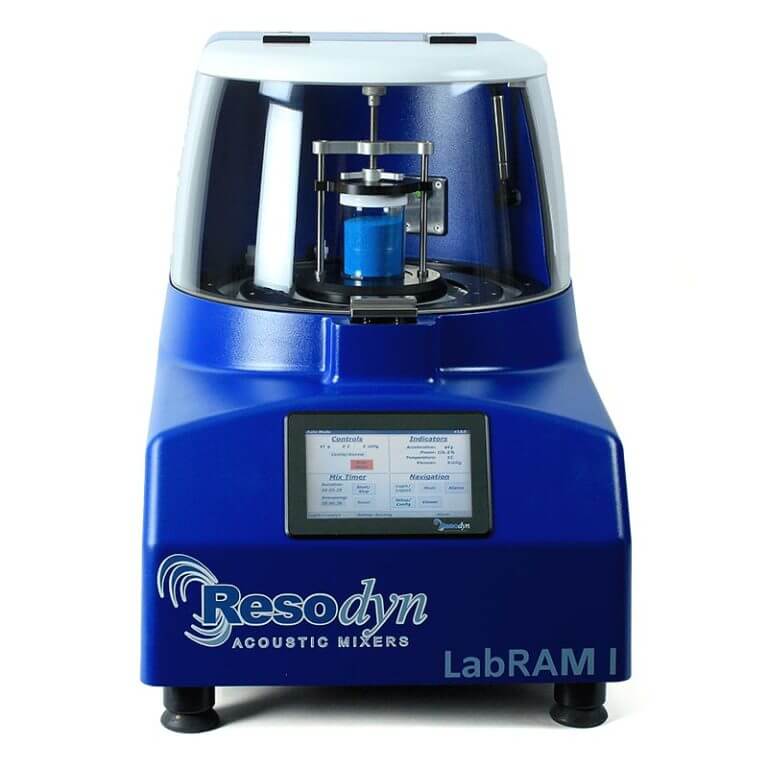
One of the most persistent headaches in industrial process development is scale-up. A mixing process validated at lab scale routinely requires extensive re-optimization when moved to pilot or production scale, because the geometry and shear profile of a larger impeller system is fundamentally different from a smaller one. With RAM, the acoustic energy is applied as acceleration — a unit that scales consistently regardless of vessel size. A process developed on the bench-top LabRAM I (500 g capacity) translates directly to the production-scale RAM 55 (over 900 lbs capacity) without requiring significant revalidation or changes to processing parameters.
Applications Where RAM’s Low Shear Advantage Is Critical
Pharmaceuticals: RAM has been adopted by major pharmaceutical companies for blending APIs with excipients, wet granulation, semi-solid compounding, and dry powder coating. The Resodyn LabRAM was the subject of a published Pfizer study evaluating its effectiveness for dry powder coating, which found it superior to conventional methods in bulk density and powder flow — all while preserving particle integrity.
Battery and Energy Storage Materials: Electrode slurry preparation for lithium-ion batteries requires thorough dispersion of conductive carbons and active materials in polymer binders like PVDF. High shear degrades PVDF and can damage the active particles themselves. RAM achieves the necessary dispersion while protecting binder and particle morphology.
Biologics and Cell-Based Materials: Shear is lethal to cells and can denature proteins or collapse vesicle structures. RAM provides a processing environment compatible with living cell suspensions, encapsulated compounds, and fragile biological matrices.
Cosmetics and Personal Care: Emulsions, creams, and serums depend on precise droplet size distributions and the preservation of active ingredients. RAM mixes these formulations without disrupting emulsion stability or degrading temperature-sensitive actives like retinols, peptides, or essential oils.
Energetic Materials: The defense and aerospace industries require mixing of materials that cannot tolerate friction, impact, or localized heat — exactly the hazards posed by conventional impeller mixing. RAM’s sealed-vessel, contact-free operation makes it uniquely suited to these applications.
Advanced Materials and Composites: Nano-particle dispersions, ceramic slurries, and filled polymer systems all benefit from RAM’s ability to achieve intimate mixing without agglomerating particles or inducing phase separation.