From Bench to Batch: Why Scale-Up Breaks So Many Mixing Processes, and How Resonant Acoustic Mixing Fixes It
A formulation that performs flawlessly in a 50-gram laboratory mixing batch can fall apart at 50 kilograms. Any process engineer who has lived through a failed tech transfer knows the pattern. The chemistry didn’t change, but the physics did. Scaling from lab to production levels is where this happens the most.
The Scale-Up Problem
- Mixing behavior doesn’t scale linearly
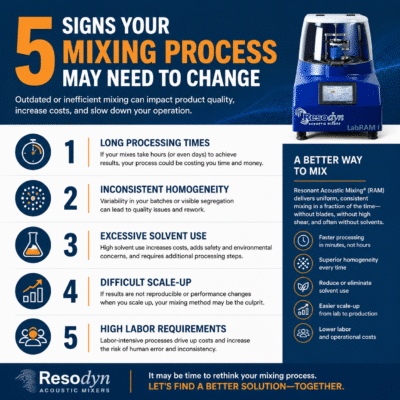
In conventional mixers, performance depends on geometry, impeller design, tip speed, shear rate, and vessel dimensions. When you move to a bigger vessel, you can’t hold all of these constant at once. Match tip speed and you change shear. Match power per volume and you change mixing time. Every scale-up becomes a compromise, and the lab-scale “recipe” rarely transfers cleanly.
- Different equipment at every stage
Many organizations develop a formulation on one type of device (a planetary mixer, overhead stirrer, or high-speed mixer in the lab), then move to a fundamentally different machine for pilot and production. Each change in equipment technology introduces new variables, new shear environments, and new dead zones. Teams end up re-developing the process at each stage rather than simply scaling it.
- Dead zones and poor homogeneity
Larger vessels have more places for material to hide. Unmixed regions near walls, corners, and shafts become more common, and high-density or high-viscosity materials make them worse. Poor homogeneity is especially costly in pharmaceutical applications, where blend uniformity and content uniformity are regulatory requirements, not nice-to-haves.
- Difficult materials
Low-dose APIs, cohesive powders, high-viscosity pastes, and materials with large density differences are notoriously hard to blend at scale. Conventional approaches often force a tradeoff between mixing quality and gentleness, which matters for fragile particles, crystal forms, or shear-sensitive ingredients.
- Shear, heat, and particle damage
Aggressive mixing can degrade polymers, break down particles, change particle size distributions, or generate heat that harms sensitive materials. What looks like adequate mixing on paper may quietly alter the product.
- Cleaning, cross-contamination, and downtime
Shafts, blades, and seals create cleaning burdens and contamination risk. For multi-product facilities and potent compounds, changeover time and cleaning validation can consume as much effort as the mixing itself. Not to mention the time and frustration of it all.
- Cost and timeline pressure
Failed scale-up means extra batches, wasted API, repeated validation, and delayed filings. When active ingredients cost thousands of dollars per gram, a mixing problem discovered late is a very expensive one.
A Different Approach to Scale-up: Resonant Acoustic Mixing
ResonantAcoustic® Mixing (RAM) takes a fundamentally different path. Instead of using impellers, blades, or paddles, RAM uses low-frequency, high-inten
sity acoustic energy for non-contact mixing. The system vibrates a mixing vessel at resonance, creating intense, uniform micro-mixing zones throughout the entire contents. Because energy is transferred through the vessel and into the material rather than through a moving part inside it, the bladeless mixing mechanism changes in a way that directly addresses the problems above.
Benefits of RAM for Scale-Up
Scalable by design
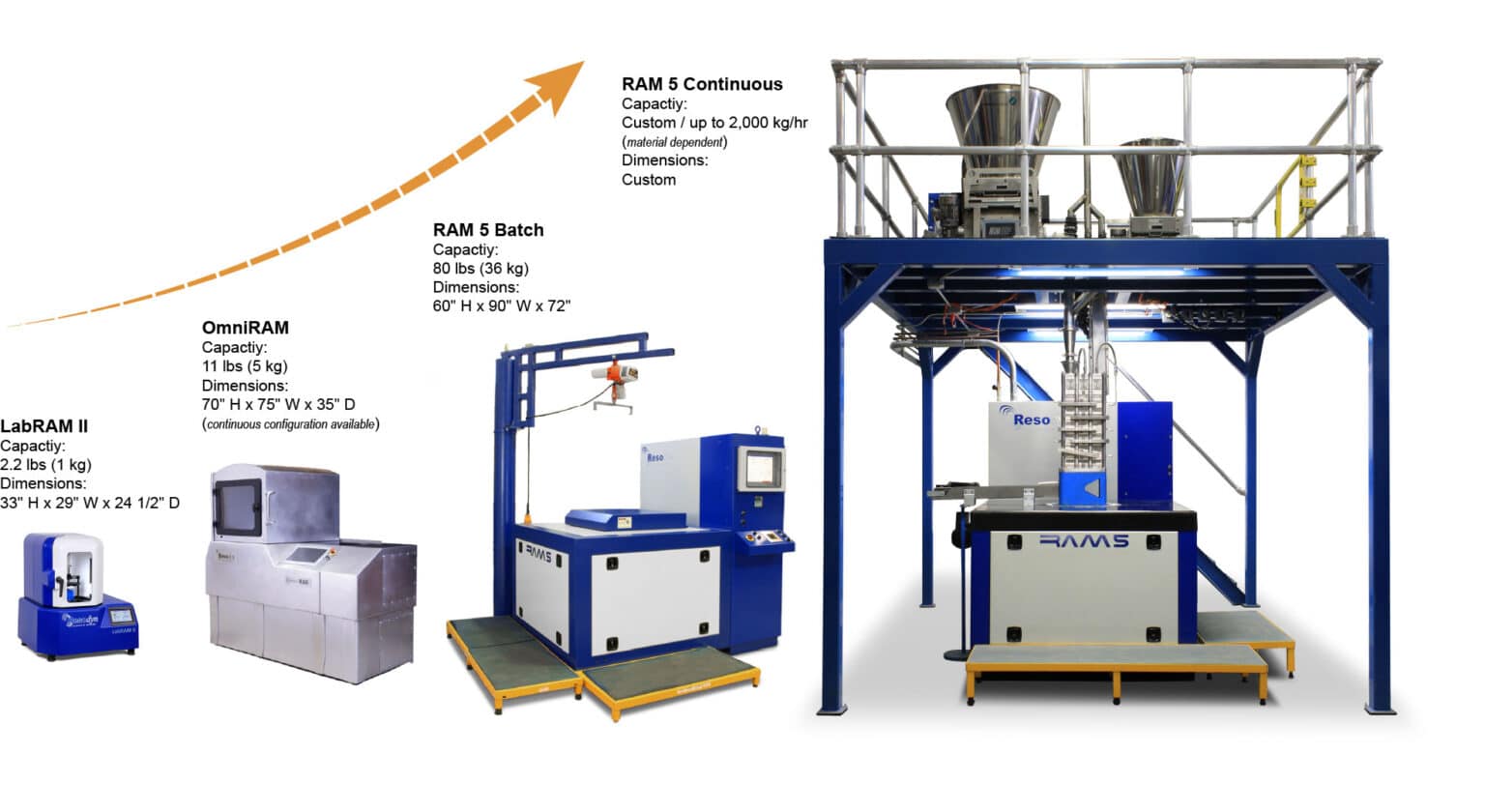
RAM operates on a consistent mixing principle across scales. Resodyn’s lineup of mixers spans small lab units for research and development work through larger systems for pilot and production, so teams can develop and scale a process on the same underlying mixing technology that performs exactly the same on every machine. It works the same on a lab mixer as it does on a production machine, no re-engineering required. That consistency reduces the number of variables changing at each step and makes tech transfer predictable.
Rapid, uniform mixing throughout the vessel
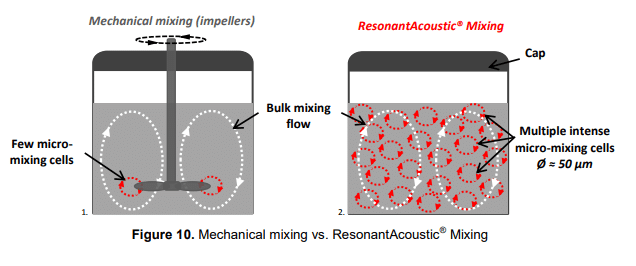
Acoustic energy creates mixing zones distributed throughout the whole vessel, not just near an impeller. That helps eliminate the dead zones that plague conventional scale-up, and it often delivers homogeneous blends in minutes rather than hours.
Handles difficult materials with ease
RAM is well suited to materials that challenge traditional mixers, including cohesive powders, high-viscosity pastes, low-dose blends, and materials with significant density differences. It can mix across a very wide viscosity range, from low-viscosity liquids to thick pastes, in the same platform.
Gentle on sensitive materials
With no blades or paddles contacting the product, RAM avoids the localized high-shear zones of impeller-based mixing. That makes it attractive for fragile particles, coated materials, crystalline forms, and other formulations where preserving structure matters.
Minimal waste and easy cleanup
Because there is no impeller or shaft, material is mixed directly in the vessel it’s loaded into. That means less product lost to mixing hardware, no parts to clean, and a lower risk of cross-contamination. For high-value or potent compounds, using the vessel as the mixing container can significantly reduce losses and changeover time.
Mix-in-case
Processors can also mix depending on their individual situation in the final case it will be used in.
Works with small and large batch sizes
RAM can work with very small sample quantities in early development, which conserves scarce API, and it supports larger volumes just the same as programs advance. Researchers can screen formulations economically and still have a simple, clear path to larger batches.
Fewer process variables, faster development
When the same mixing mechanism carries a formulation from the first experiment to commercial-scale batches, teams spend less time re-optimizing and more time advancing the product. Faster development cycles and fewer failed scale-up attempts translate directly into saved time and cost.
Broad application range
Although RAM is widely used in pharmaceutical development, the same capabilities benefit other industries facing similar challenges, including energetics, advanced materials, batteries, and specialty chemicals.
The Bottom Line
Scale-up fails when the process changes faster than the team can understand it. By removing impellers, dead zones, and shear-driven variability, and by offering a consistent mixing mechanism from lab to production, Resonant Acoustic Mixing gives development teams a predictable path from the first gram to the final batch.
To review the entire line of Resodyn’s Acoustic Mixing Technology visit our product pages.