
The Hidden Costs of High Shear Mixing, and a Better Way to Mix
A practical guide for formulators, process engineers, and R&D teams
High shear mixing is a workhorse. Rotor-stator mixers, high-speed dispersers, and similar devices are everywhere because they are fast, familiar, and effective at breaking down agglomerates and forming emulsions. But for a growing number of modern formulations, the same intensity that makes high shear useful also creates problems. This guide covers where high shear falls short and how Resonant Acoustic Mixing (RAM) addresses those gaps.
Part 1: The Downsides of High Shear Mixing
- Localized intensity, uneven energy
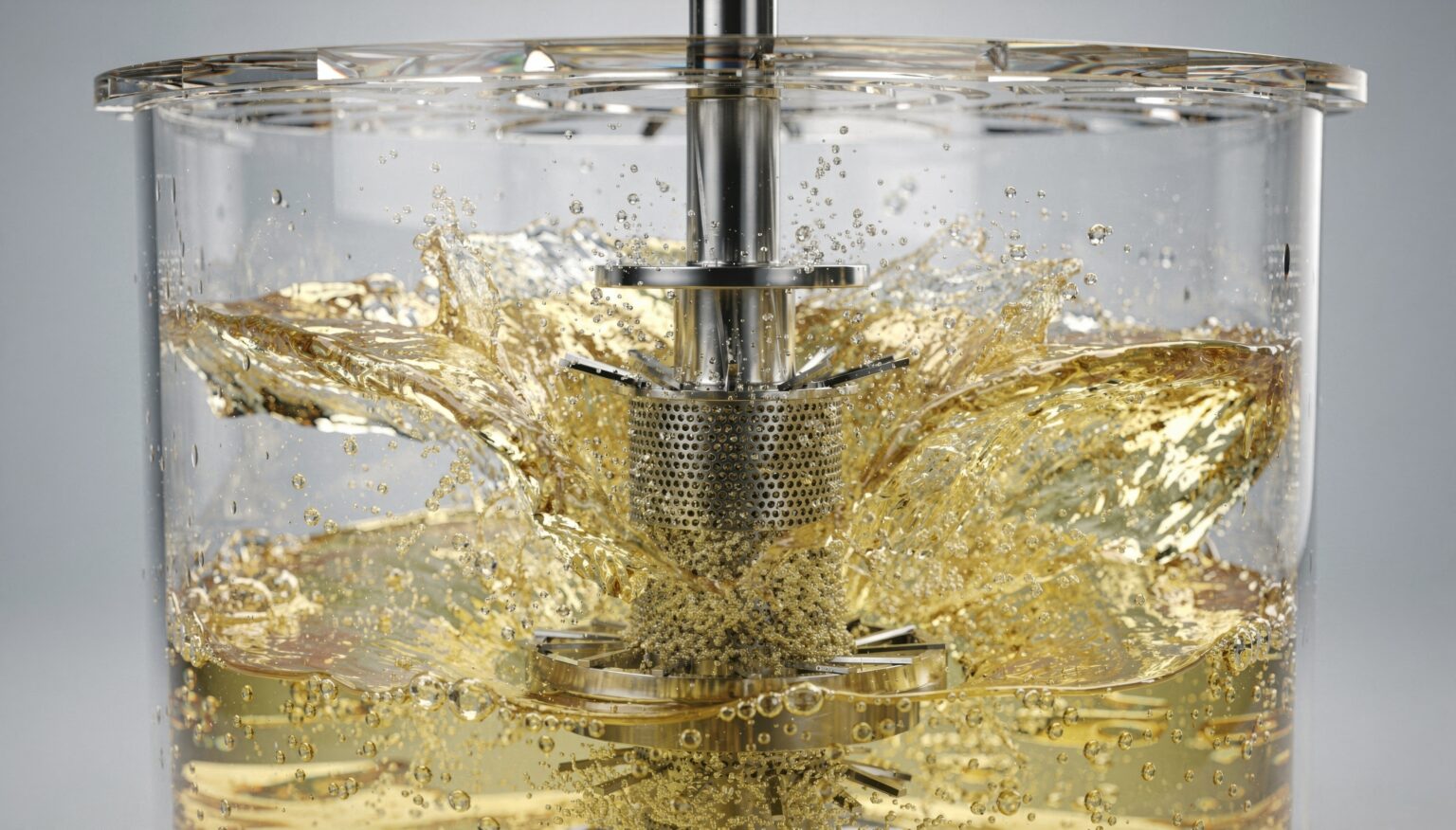
In a high shear mixer, almost all of the energy is delivered in a small zone around the rotor, blade, or screen. Material has to travel to that zone to be processed. Everything else in the vessel gets far less energy. The result is a steep gradient: over-processed material near the mixing head and under-processed material elsewhere, especially with thick or dense products.
- Heat generation
Intense shear converts mechanical energy into heat. In viscous materials, temperature can climb quickly, which is a problem for heat-sensitive APIs, polymers, biologics, and reactive or energetic materials. Teams often have to add cooling jackets, pause mixing, or limit batch times, all of which complicate the process.
- Particle damage and unintended size changes
High shear can fracture crystals, reduce particle size, round off particle morphology, or damage coatings. If particle size distribution is a critical quality attribute, aggressive mixing can quietly change the product. This can be a real issue for controlled-release formulations, coated particles, and fragile crystalline materials.
- Polymer and structure degradation
Long-chain polymers can be sheared and broken, reducing molecular weight and changing rheology. Structured systems such as gels, suspensions, and some emulsions can lose their intended microstructure when over-sheared.
- Air entrainment
Fast-moving blades and rotors pull air into the product. Trapped air shows up as foam, voids, density variation, and inconsistent fill weights. Removing it often requires an extra de-aeration or vacuum step.
- Scale-up unpredictability
Shear rate, tip speed, power per volume, and mixing time cannot all be held constant as vessel size increases. A process tuned on a lab-scale rotor-stator often behaves differently on a production unit with different geometry, so each scale step may need re-development.
- Cleaning, contamination, and product loss
Rotors, stators, shafts, seals, and screens are difficult to clean and validate. They can trap product, which is costly with expensive or potent materials, and moving parts can introduce wear particles or cross-contamination risks.
- Limits with difficult materials
High viscosity pastes, cohesive powders, and materials with big density differences can cause the mixing head to cavitate, stall, or simply fail to circulate the full batch. Low-dose blends are hard to disperse evenly when material has to find its way to a small processing zone.
Part 2: How Resonant Acoustic Mixing Is Different
ResonantAcoustic® Mixing uses low-frequency, high-intensity acoustic energy to mix material inside a sealed vessel. There are no impellers, blades, or paddles. The system drives the vessel at resonance, which creates a field of micro-mixing zones distributed throughout the entire contents, rather than concentrating energy at one point.
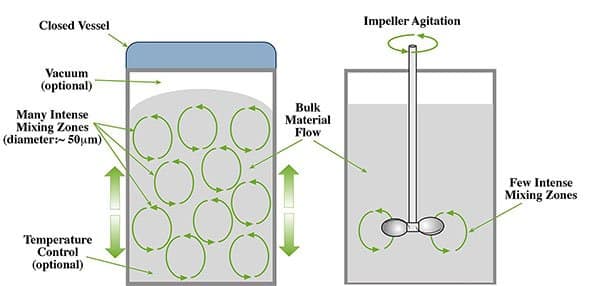
That one design difference changes the answer to each problem above.
| High shear problem | How RAM addresses it |
| Energy concentrated near the mixing head | Energy is distributed throughout the whole vessel, so material is processed uniformly instead of traveling to a high-energy zone |
| Heat buildup from intense local shear | No localized high-shear zone, which reduces the hot spots typical of rotor-stator mixing |
| Particle fracture and morphology change | No blades or rotors striking the material, which suits fragile particles, coated materials, and crystalline forms |
| Polymer and microstructure damage | Gentler, more uniform mixing helps preserve sensitive structures |
| Air entrainment | Mixing occurs in a closed vessel without a rotating head churning in air from the surface |
| Scale-up variability | The same mixing principle carries across lab, pilot, and production-scale systems |
| Cleaning and product loss | No internal mixing hardware to clean, and material can be mixed directly in its own container |
| Difficult materials | Handles a wide range of materials, from low-viscosity liquids to thick pastes and cohesive powders |
Part 3: Benefits at a Glance
- Uniformity: Distributed mixing reduces dead zones and over/under-processed regions.
- Gentleness: Low shear mixing, without contact from internal mixing parts, sensitive materials are better protected.
- Speed: Many blends reach homogeneity in minutes.
- Flexibility: One platform covers powders, liquids, pastes, and slurries.
- Efficiency: Less cleaning, less waste, and lower cross-contamination risk.
- Scalability: A consistent mechanism from small development batches to larger volumes.
- Small-batch friendly: Useful when early-stage materials are scarce or expensive.
Part 4: Is RAM Right for Your Process? A Quick Checklist
RAM is worth evaluating if you answer "yes" to any of these:
- Is your formulation sensitive to heat, shear, or particle attrition?
- Are you blending low-dose actives or materials with large density differences?
- Do you work with viscous pastes or cohesive powders that stall conventional mixers?
- Have you had scale-up surprises moving from lab to pilot to production?
- Is cleaning validation or product loss a significant cost?
- Are you working with expensive, potent, or limited-supply materials?
- Do you need to avoid foaming or air incorporation?
A Note on Fit
High shear mixing is still the right tool for some jobs, such as deliberately reducing particle or droplet size or forming certain emulsions where intense shear is the goal. RAM is best understood as the solution for the many applications where the goal is uniform, gentle, scalable blending, not size reduction. Testing your own materials is the most reliable way to know which approach fits.
Next Steps
Evaluate RAM with your own formulation. Contact Resodyn to discuss your application and arrange a free demonstration.