How Resonant Acoustic Mixing Enables Dry Electrode Processing for Lithium-Ion Batteries
As global demand for lithium-ion batteries continues to surge, manufacturers are seeking more efficient, sustainable, and scalable production methods. One of the most promising innovations is dry electrode processing, a solvent-free approach that simplifies manufacturing and reduces environmental impact.
A key technology enabling this shift is Resonant Acoustic Mixing (RAM)—an advanced method for battery powder mixing that delivers superior homogeneity, faster processing times, and improved material performance.
Why Dry Electrode Processing Matters in Battery Manufacturing
Traditional lithium-ion battery manufacturing relies on slurry-based electrode fabrication, where active materials, conductive additives, and binders are mixed with solvents such as NMP. While widely used, this process has several drawbacks.
These drawbacks include high energy consumption from solvent drying and long processing times, often ranging from 12 to 30 hours. There's also the environmental and regulatory concerns that come along when using solvents. You also need complex battery processing equipment and large factory footprints are required.
Dry electrode processing eliminates solvents entirely, offering these benefits:
- Lower manufacturing costs and less equipment needed
- Significantly reduced energy usage
- Simplified production lines
- Faster throughput
However, achieving uniform powder blending without liquids is a major technical challenge, which is why RAM is so important for this reason.
What is Resonant Acoustic Mixing?
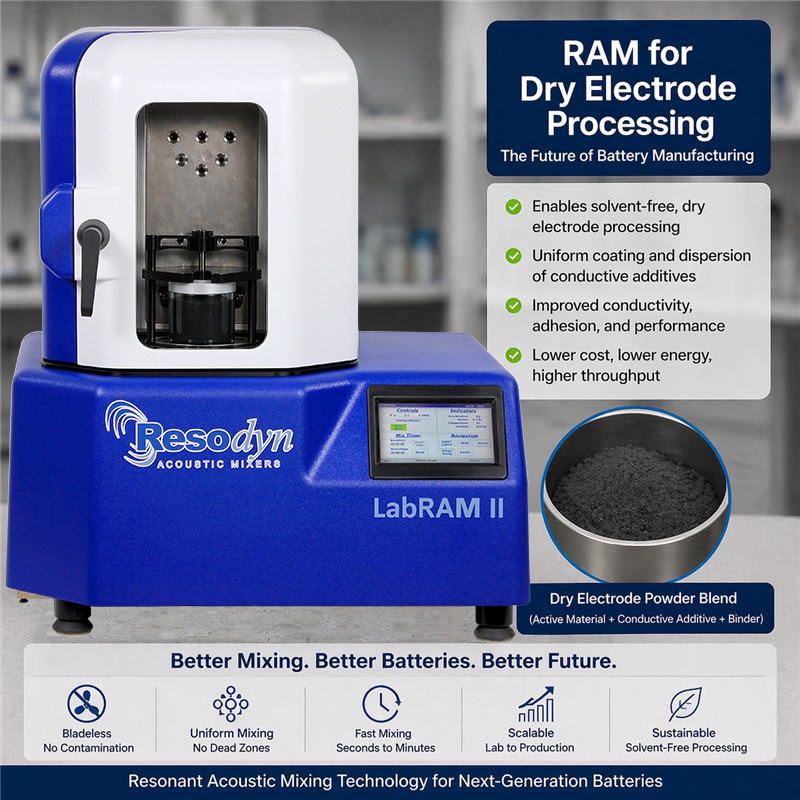
Resonant Acoustic Mixing (RAM) is a high-intensity, non-contact mixing technology that uses low-frequency acoustic energy to fluidize and blend materials inside a sealed container.
Unlike traditional mixers, RAM:
- Requires no blades or impellers
- Uses no grinding media
- Provides uniform energy distribution
- Mixes powders, pastes, and viscous materials uniformly, usually in minutes
This makes it ideal for dry electrode fabrication and advanced material processing.
Improving Battery Powder Mixing and Homogeneity
In lithium-ion batteries, the performance of an electrode depends heavily on the distribution of conductive additives such as carbon black or carbon nanotubes.
Poor dispersion leads to reduced electrical conductivity, lower capacity and efficiency, and inconsistent battery performance.
RAM enhances conductive additive dispersion by breaking up agglomerates, promoting particle-to-particle interaction, and creating a uniform conductive network. This results in highly homogeneous powder blends, critical for high-performance electrodes.
Enabling Dry Particle Coating for Battery Materials
One of the most powerful capabilities of RAM is dry particle coating, where fine additives adhere to the surface of larger particles without solvents.
In lithium-ion battery manufacturing, this enables coating cathode materials with conductive carbon, uniform binder distribution and enhanced particle contact and adhesion.
Benefits of dry particle coating include improved electrical pathways, better cycle life and stability, and reduced need for additional processing steps
Eliminating Contamination in Electrode Fabrication
Traditional mixing methods like ball milling introduce grinding media, which can contaminate sensitive battery materials.
Resonant Acoustic Mixing eliminates this risk by operating without media, ensuring higher material purity, consistent electrochemical performance, reduced risk of defects.
This is especially important in advanced battery blending applications, where even trace contamination can impact performance.
Faster, Scalable Battery Manufacturing
RAM significantly reduces processing time compared to conventional methods:
- Mixing completed in seconds to minutes
- No drying stage required
- Simplified production workflow
Additionally, RAM technology is highly scalable, allowing seamless transition from lab-scale R&D, pilot production and full-scale battery manufacturing. This scalability is essential for meeting growing demand in the EV and energy storage markets.
The Future of Dry Electrode Processing
As the battery industry shifts toward solvent-free manufacturing, technologies like Resonant Acoustic Mixing will play a critical role in overcoming key challenges in powder mixing and electrode fabrication.
By enabling:
- Efficient battery powder mixing
- Uniform conductive additive dispersion
- Advanced dry particle coating
- Faster, cleaner production processes
RAM is helping drive the next generation of lithium-ion battery manufacturing.
Conclusion
Resonant Acoustic Mixing is a powerful enabler of dry electrode processing, solving one of the most difficult challenges in battery manufacturing: achieving consistent, high-quality powder blends without solvents.
As demand for high-performance, cost-effective batteries grows, RAM offers a scalable, efficient, and sustainable solution for the future of energy storage.