

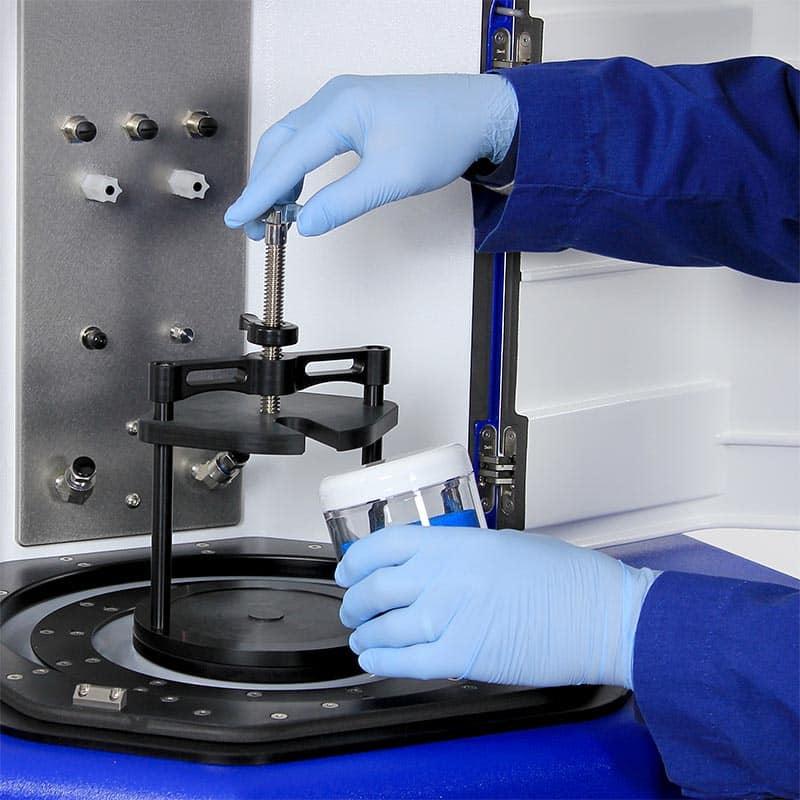
LabRAM II
Laboratory Mixer
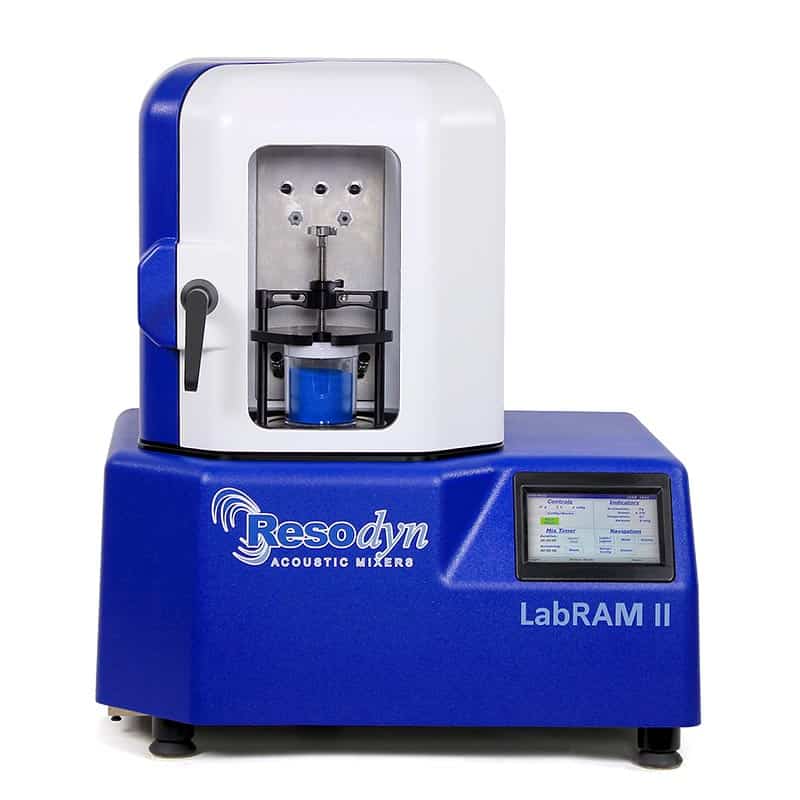
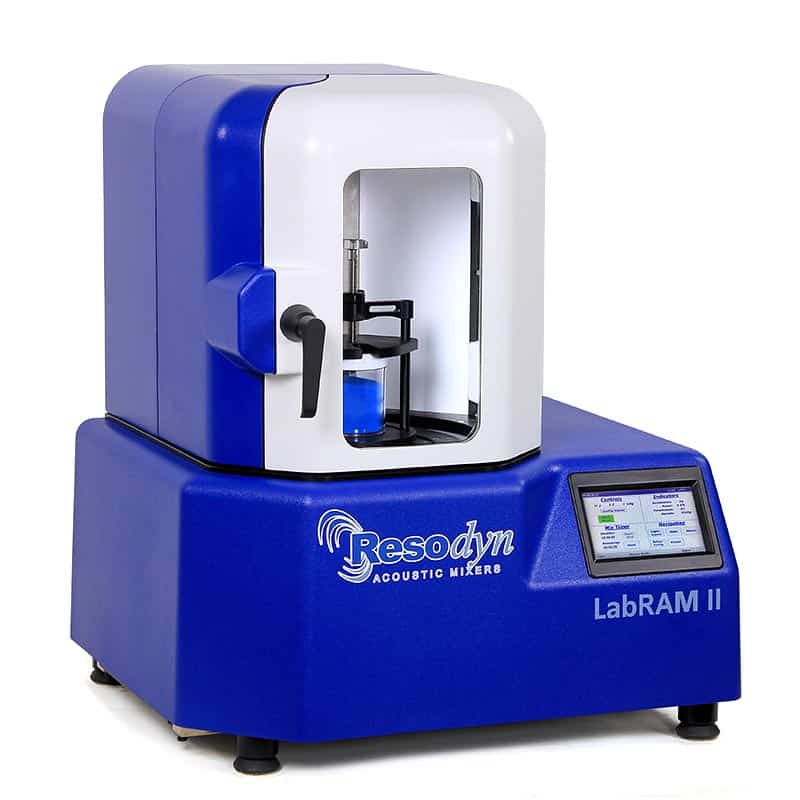
The LabRAM II™ is a high-performance acoustic mixer designed to bridge the gap between laboratory development and mid-scale production.
Engineered for speed, precision, and flexibility, it delivers efficient, highly repeatable mixing across a wide range of materials, from powders and liquids to viscous slurries. The machine can process 2.2 lb (1 kg). With an intuitive touchscreen interface, robust data tracking, and scalable processing capabilities, the LabRAM II™ enables faster formulation development while maintaining consistency from lab to production.
Need a custom solution? All mixers can be customized for unique automations and applications.
Built for Diverse and Demanding Processing Applications
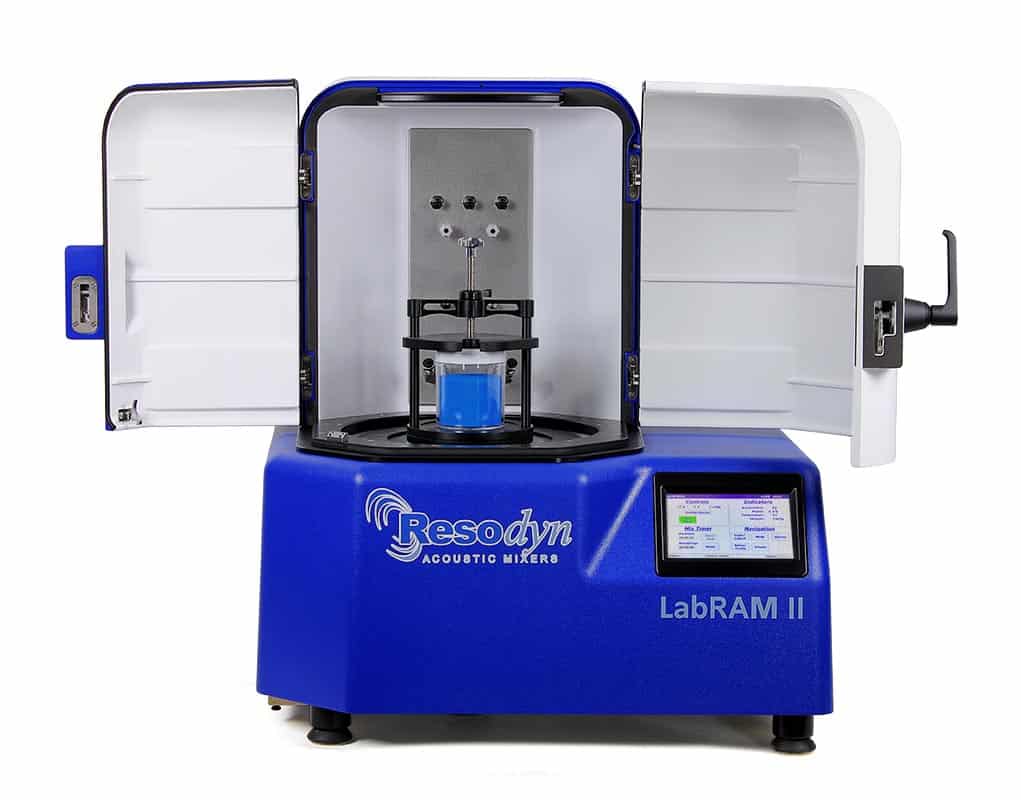
The LabRAM II™ is built to handle diverse and demanding processing applications with a high degree of control and consistency. Its acoustic mixing technology allows for intense yet low-shear blending, making it suitable for sensitive materials while still achieving rapid, uniform results. Designed with flexibility in mind, it supports a wide range of vessel types, processing conditions, and optional accessories to meet evolving development needs.
Beyond its core capabilities, the LabRAM II™ is designed to streamline workflows and improve process reliability. Its integrated human-machine interface (RAMWare) simplifies operation, while built-in data management tools support documentation and optimization. The system’s ability to scale directly to larger RAM platforms ensures that processes developed at the lab level can transition to production without added complexity or increased processing time.
Key Processing Capabilities
- Processes 2.2 lb (1 kg) per batch
- Handles solids, powders, liquids, gases, and viscous materials
- Supports milling, grinding, sieving, and coating (spray or dry)
- Enables temperature control from -40°F (-40°C) to 392°F (200°C) (optional)
- Offers vacuum processing down to 10 Torr (optional)
- Process data download for analysis, documentation, and compliance reporting
- Stores up to 100 recipes for repeatable operations
Key Advantages
- 10–100x faster processing compared to traditional mixers
- Highly repeatable results for consistent product quality
- Direct scalability across the RAM product line
- Exceptional ingredient distribution
- Erase cross contamination concerns and eliminate cleaning.
- Process previously unmixable ingredients
- Used worldwide in 40+ countries at 100's of universities, fortune 500 companies, governments and national laboratories.
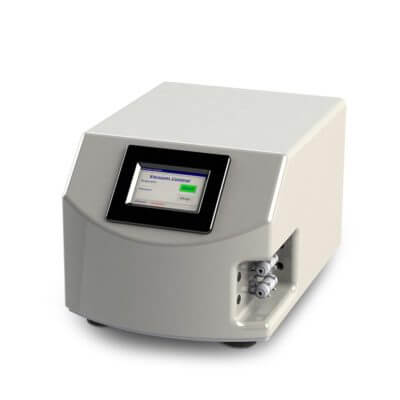
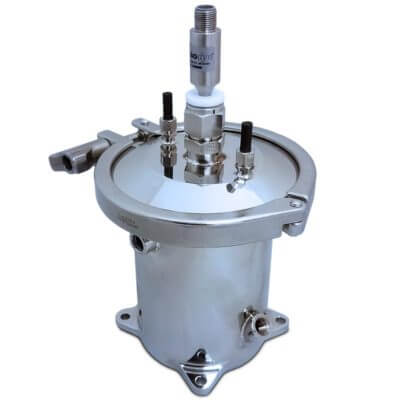
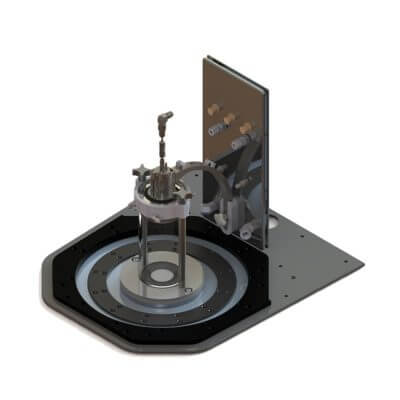
The Most Capable Bench-Scale Mixer Ever
The LabRAM II™ is Resodyn's flagship bench-scale ResonantAcoustic® Mixer — a full-featured, digitally controlled mixing and processing system built for laboratories and development environments that demand speed, precision, and the gentlest possible treatment of sensitive materials.
With a payload capacity of up to 2.2 lbs (1 kg) and acceleration up to 100 g at 60 Hz, the LabRAM II delivers intense, bladeless, non-contact mixing across the widest range of materials available in any bench-top mixer: dry powders, liquids, slurries, pastes, and high-viscosity materials up to and beyond 10 million cP. No impellers. No shear damage. No compromises.
Why the LabRAM II?
Speed. RAM technology achieves thorough homogenization in minutes — 10× to 100× faster than conventional impeller methods for comparable blend quality.
Quality. Uniform, distributed energy means no dead zones and no over-mixed regions. The result is a consistently superior blend, batch after batch.
Safety. Sealed-vessel mixing eliminates exposure risk, cross-contamination, and the cleanup burden associated with impeller cleaning and validation.
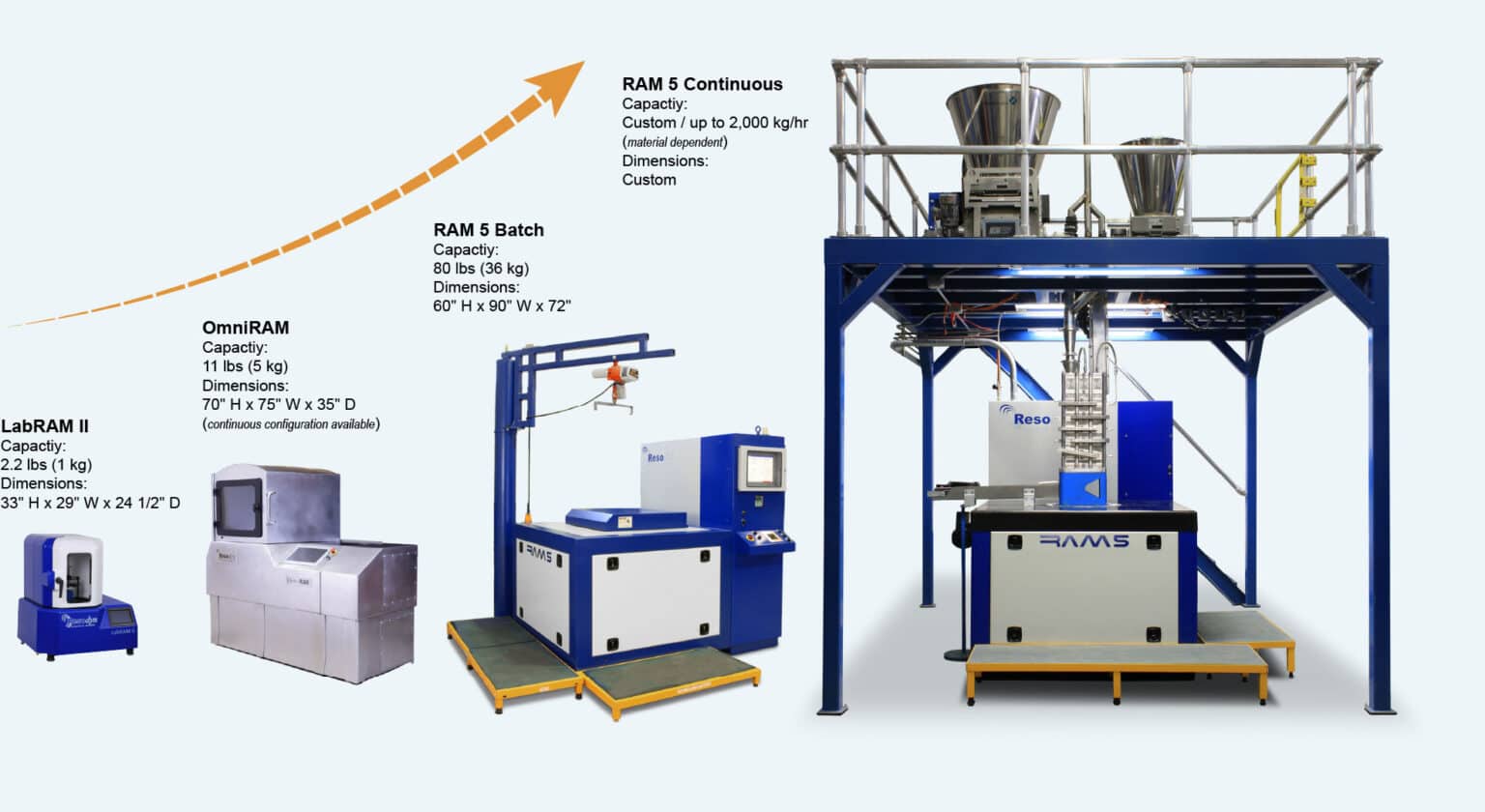
Scalability. Process parameters developed on the LabRAM II translate directly to larger RAM platforms — OmniRAM, RAM 5, RAM 55 — without requiring re-optimization. What you develop at the bench is what you produce at scale.
Ideal For
- Pharmaceutical API blending, wet granulation, and semi-solid compounding
- Battery electrode slurry preparation
- Cosmetic and personal care formulation
- Polymer and advanced materials processing
- Biological and cell-based compound processing
- R&D and process development in any industry requiring low shear, high uniformity mixing
"…[we] mix different rheologies with powder metals, highly viscous, and the LabRAM II has proven it can do that effectively. We're very impressed with the build quality of the mixer--it's a nice, solid, well-thought-out piece of equipment. It's done very well for us."
-U.S. National Laboratory
The LabRAM II is part of Resodyn's complete ResonantAcoustic® Mixer product family, which scales from the LabRAM I (500 g) through the production-scale RAM 55 (920+ lbs). All products are manufactured in Butte, Montana, USA, and operate in over 40 countries worldwide.
For specifications, pricing, or to arrange a free demonstration using your materials, contact Resodyn Acoustic Mixers at info@resodynmixers.com or +1 (406) 497-5333.
Direct RAM Scalability
ResonantAcoustic® mixing scaled to your needs, from the lab to the production floor.